Understanding Greater Than and Less Than – Fun Math for Kids
Learning numbers is exciting, and understanding “greater than” (>) and “less than” (<) is an important step in developing math skills. These concepts teach children how to compare numbers, which is a foundation for addition, subtraction, and problem-solving. With fun, interactive activities, kids can learn to identify which numbers are bigger, smaller, or equal while enjoying the process.
Thank you for reading this post, don't forget to subscribe!Why Kids Need to Learn Greater Than and Less Than
-
Number Comparison Skills – Children learn to compare two numbers and determine which is bigger or smaller.
-
Early Math Foundation – These concepts prepare children for addition, subtraction, and place value.
-
Problem-Solving Abilities – Comparing numbers helps develop logical thinking and reasoning.
-
Confidence with Numbers – Understanding comparisons builds confidence in math and number sense.
-
Interactive Learning – Using objects, games, and worksheets makes abstract concepts concrete.
By mastering “greater than” and “less than,” children can confidently approach more advanced math concepts in later grades.
What Are Greater Than and Less Than?
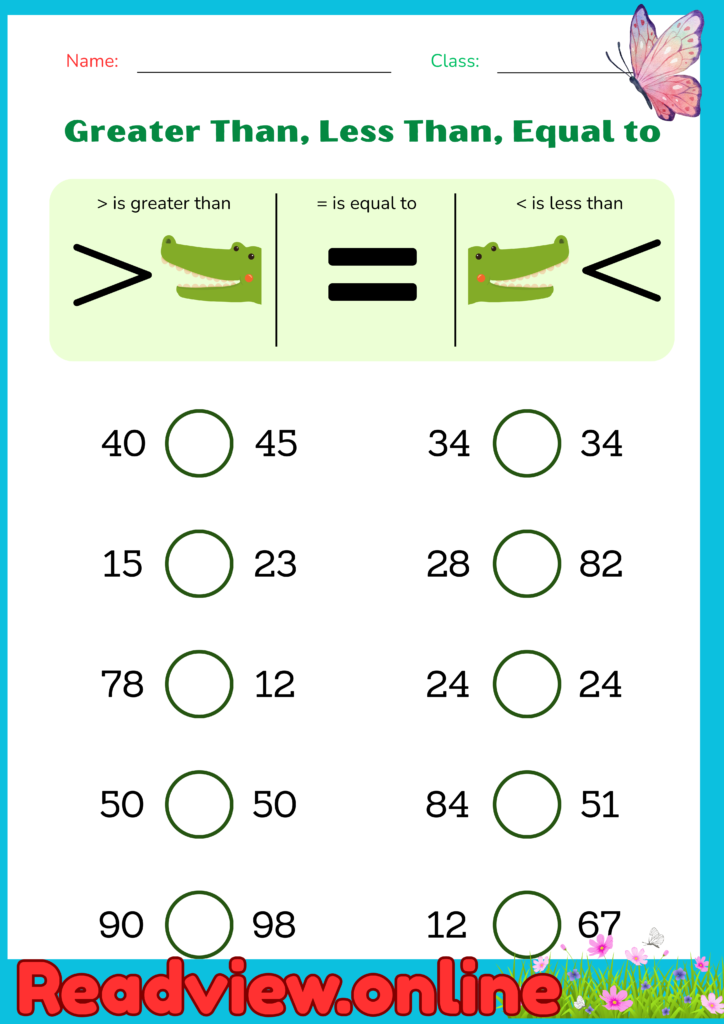
Greater Than (>) – A number that is larger than another number.
Less Than (<) – A number that is smaller than another number.
For example:
-
5 > 3 (5 is greater than 3)
-
2 < 7 (2 is less than 7)
Children often use visual aids like objects, pictures, or number lines to understand these concepts.
Fun Ways to Teach Greater Than and Less Than
1. Use Objects for Comparison
Place two sets of objects in front of children, like apples or blocks. Ask: “Which group has more?” or “Which group has fewer?” This hands-on activity helps kids visualize numbers.
2. Number Line Activities
Draw a number line and place numbers on it. Children can see which numbers are higher or lower and practice using > and < signs.
3. Story-Based Learning
Create small stories:
“Tom has 6 balloons, and Sara has 4 balloons. Who has more? Who has less?”
Children enjoy solving problems through storytelling while practicing comparison.
4. Worksheets and Coloring
Provide worksheets where children color the greater number or circle the smaller number. Adding coloring makes learning interactive and fun.
5. Games and Challenges
-
Greater vs. Less Race: Use cards with numbers and ask children to pick the greater or smaller number quickly.
-
Dice Comparison: Roll two dice, compare numbers, and use > or < signs.
-
Math Puzzles: Match numbers with objects to compare quantities.
Skills Developed Through Greater Than and Less Than Activities
-
Number Sense – Understanding how numbers relate to each other.
-
Logical Thinking – Making decisions based on numerical comparisons.
-
Math Confidence – Practicing comparisons makes children more confident in solving math problems.
-
Observation and Attention – Spotting differences in quantities improves focus.
-
Fine Motor Skills – Writing > and < signs and coloring objects strengthen hand coordination.
Tips for Parents and Teachers
-
Encourage children to use real objects like fruits, toys, or blocks.
-
Praise children for correct answers and effort to build confidence.
-
Gradually increase difficulty, from single-digit numbers to double-digit numbers.
-
Include visual aids and charts to make abstract concepts tangible.
-
Make learning playful, with games, challenges, and storytelling.
Examples for Practice
-
Circle the greater number: 7 or 5 → 7
-
Fill in the blank: 3 __ 8 → <
-
Which has fewer items? 🍎🍎🍎 or 🍎🍎🍎🍎🍎 → First group
-
Use signs: 12 __ 9 → >
-
Draw more: Show 4 stars and 6 stars, color the bigger group.
Making Learning Fun
Children learn best when they play, explore, and experiment. Using comparisons with food, toys, or classroom objects makes greater than and less than relatable. Storytelling, drawing, and coloring keep the child engaged and help concepts stick in memory.
Conclusion
Understanding greater than and less than is a crucial math skill that forms the foundation for all future number operations. By combining hands-on activities, worksheets, stories, and games, children can learn these concepts confidently and enjoyably.
When children actively read, write, and explore numbers, they not only learn math but also develop observation, problem-solving, and critical thinking skills. Teaching greater than and less than in a fun, interactive way ensures that kids develop a lifelong love for numbers and learning.