Find the Nature Items: Explore, Learn, and Play
Nature is full of wonders waiting to be discovered. From trees and flowers to rocks and clouds, children can learn a lot by exploring the world around them. “Find the Nature Items” is a fun activity that helps kids observe, recognize, and categorize natural objects while boosting their vocabulary, concentration, and creativity.
Thank you for reading this post, don't forget to subscribe!Why Learning About Nature Matters
-
Observation Skills: Kids learn to notice shapes, colors, and patterns in nature.
-
Vocabulary Building: Learning names of leaves, flowers, fruits, and animals.
-
Creativity and Imagination: Making stories about nature encourages thinking.
-
Healthy Lifestyle: Encourages outdoor play and exploration.
-
Environmental Awareness: Fosters respect for nature and wildlife.
Examples of Nature Items to Find
Here are some items children can explore:
-
Leaves – Big, small, round, or pointed.
-
Rocks – Smooth, rough, or colorful stones.
-
Flowers – Roses, sunflowers, daisies, and more.
-
Fruits – Apples, berries, and oranges.
-
Seeds – Acorns, pine cones, or sunflower seeds.
-
Insects – Ladybugs, ants, and butterflies.
-
Clouds and Sky – Shapes of clouds, birds, or the sun.
Children can collect, draw, or color these items to enhance memory and learning.
Storytime: Nature Treasure Hunt
One morning, Ali and Sara went on a nature treasure hunt in their garden.
“Look, Sara! I found a red leaf!” said Ali.
“And I see a tiny ladybug crawling on the flower,” replied Sara.
They collected rocks, seeds, and flowers, and even made a small nature collage.
Ali said, “Nature is full of surprises!”
This story encourages children to observe and interact with nature, while learning the names of different items.
Fun Activities: Find the Nature Items
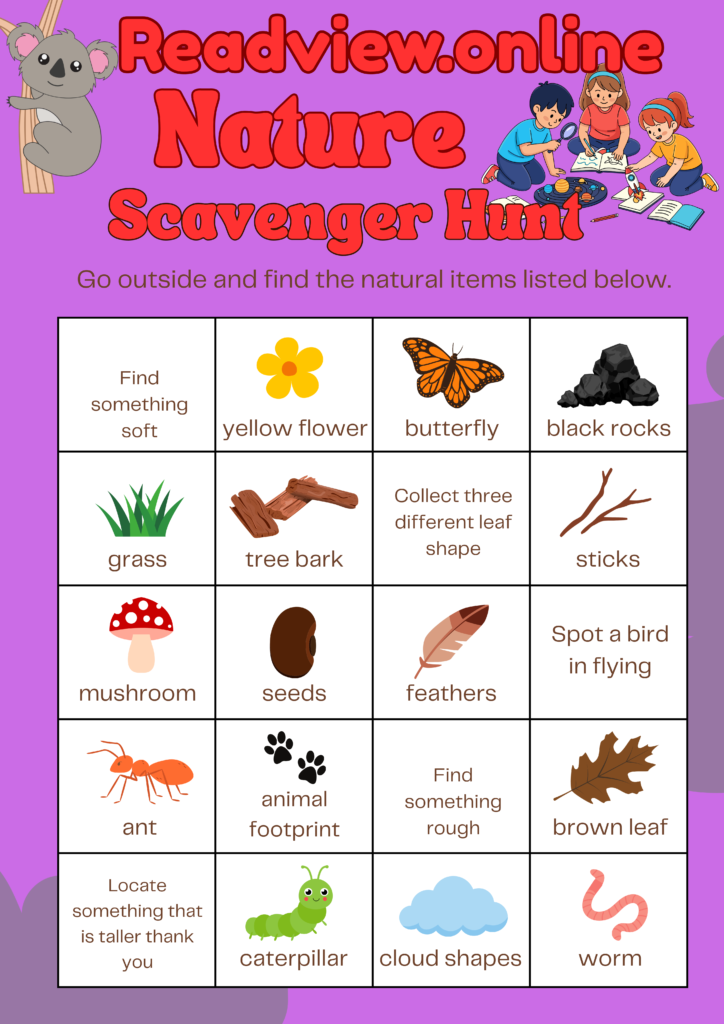
1. Nature Scavenger Hunt
-
Give children a list of items to find: leaf, stone, flower, feather, or twig.
-
Ask them to tick each item as they find it.
-
Outdoor activity that enhances observation and excitement.
2. Draw and Color
-
Draw collected items on paper.
-
Color them as realistically or creatively as possible.
-
Improves fine motor skills and creativity.
3. Sort and Classify
-
Group items by color, size, or type.
-
Example: Green leaves, red flowers, smooth stones.
-
Teaches categorization and critical thinking.
4. Nature Story Creation
-
Make short stories using collected items.
-
Example: “The acorn rolled down the hill and met a tiny ant.”
-
Encourages imagination and writing skills.
5. Pronunciation and Vocabulary Game
-
Name each item aloud and spell it.
-
Repeat with friends or siblings to reinforce memory.
Skills Developed Through Nature Exploration
-
Observation and Attention: Spotting details in nature.
-
Cognitive Skills: Sorting, categorizing, and comparing items.
-
Creativity: Drawing, storytelling, and coloring.
-
Vocabulary Development: Learning the names of natural objects.
-
Outdoor Learning: Encourages physical activity and environmental awareness.
Tips for Parents and Teachers
-
Take children outside whenever possible: parks, gardens, or schoolyards.
-
Encourage them to ask questions about plants, rocks, insects, or animals.
-
Use collected items for crafts, collages, or worksheets.
-
Praise effort and creative thinking instead of just correct answers.
-
Make it a daily or weekly activity for continuous learning and exploration.
Conclusion
Finding and exploring nature items is a fun, educational, and interactive activity for children. It teaches vocabulary, observation, creativity, and environmental awareness.
Through scavenger hunts, coloring, drawing, and storytelling, kids connect with nature while developing important skills. Exploring nature not only makes learning fun but also encourages a lifetime of curiosity and respect for the environment.