Reading Phrases: Learn to Read Words Together
Reading phrases helps children move beyond reading single words to reading groups of words together. Phrases are small groups of words that form meaningful ideas, such as “The red ball” or “A big tree.”
Thank you for reading this post, don't forget to subscribe!Learning to read phrases improves fluency, comprehension, and confidence in young readers.
This skill is perfect for kids’ books, worksheets, classrooms, and home learning activities.
What Are Reading Phrases?
Reading phrases means reading two or more words together without pausing after each word. It helps children understand the meaning of the words as a group.
For example:
-
“The small cat”
-
“A green leaf”
-
“Run to school”
By practicing phrases, children read more smoothly and understand stories better.
Why Reading Phrases Is Important
-
Improves reading fluency: Reading groups of words smoothly
-
Enhances comprehension: Children understand the meaning of a phrase
-
Builds vocabulary: Recognizing phrases with common words
-
Boosts confidence: Reading in phrases feels more natural
-
Prepares for sentence reading: Helps move from words to full sentences
Examples of Simple Phrases
-
The red ball
-
A big tree
-
The happy dog
-
My yellow hat
-
Run to school
Children can read aloud, underline, or color phrases to remember them better.
Short Story: Learning Phrases
Ali was learning to read at home. His teacher said,
“Read the phrase: The blue car.”
Ali read aloud slowly at first, then faster:
“The… blue… car… The blue car!”
He smiled, “I can read phrases now!”
By practicing phrases, Ali learned to read more smoothly and confidently.
Fun Reading Phrase Activities
1. Read and Point
Write phrases on paper and ask children to point to each word while reading.
2. Match the Phrase
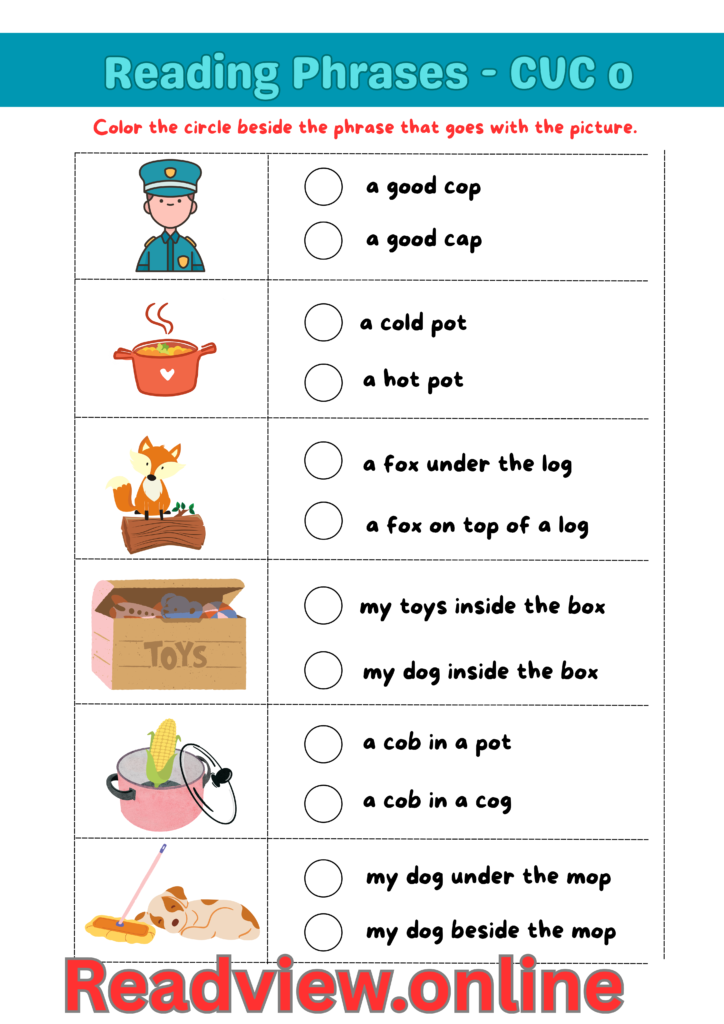
Match written phrases with pictures that show their meaning.
3. Colour the Phrase
Color each word in a phrase with different colors to make it memorable.
4. Phrase Flashcards
Use cards with phrases and read them aloud quickly, helping fluency.
5. Phrase Stories
Combine phrases to make short stories. Example:
-
“The red ball. The happy dog. Run to school.”
Skills Developed Through Reading Phrases
-
Reading fluency and speed
-
Vocabulary building
-
Comprehension and meaning recognition
-
Confidence in reading
-
Preparation for reading sentences and stories
Tips for Parents and Teachers
-
Start with short and simple phrases
-
Read aloud with children and encourage repetition
-
Use pictures to show the meaning of phrases
-
Praise children for reading smoothly, not just correctly
-
Make learning fun and interactive
Conclusion
Reading phrases is a key step for children to move from reading single words to reading sentences. By practicing phrases through pictures, flashcards, and stories, children develop fluency, comprehension, and confidence in reading.
Learning phrases makes reading more natural, enjoyable, and meaningful for young learners.